
What is a calorie deficit?
Your body uses energy all day: to keep you alive at rest, to digest food and to move. When the energy you eat is consistently lower than the energy you use, your body makes up the difference from its stores and body weight tends to fall over time.
Day-to-day weight also moves with water, salt, digestion and hormones, so a deficit does not show up neatly on the scale every morning.
Step 1: Estimate your maintenance calories
Maintenance calories, also called total daily energy expenditure (TDEE), are the calories you would eat to keep your weight roughly stable. A common way to estimate them is to calculate your basal metabolic rate (BMR) with the Mifflin–St Jeor equation, then multiply by an activity factor.
Use the free calorie calculator to get an estimate in a few seconds. Choose the activity level that describes a typical week, not your best one.
Step 2: Choose a moderate deficit
A smaller deficit is usually easier to keep up. Many people start somewhere between 250 and 500 kcal below maintenance. A rough rule of thumb is that a 500 kcal daily deficit adds up to around 0.5 kg (about 1 lb) a week, but real-world change varies from person to person and often slows over time.
The NHS suggests aiming to lose around 0.5 to 1 kg (1 to 2 lb) a week. Very low-calorie diets should only be followed with medical supervision.
Step 3: Track your intake consistently
A target is only useful if you know roughly what you are eating. You do not need to weigh every meal; consistent, honest estimates are more valuable than occasional perfect ones. Our guide to counting calories without a scale covers practical ways to estimate portions.
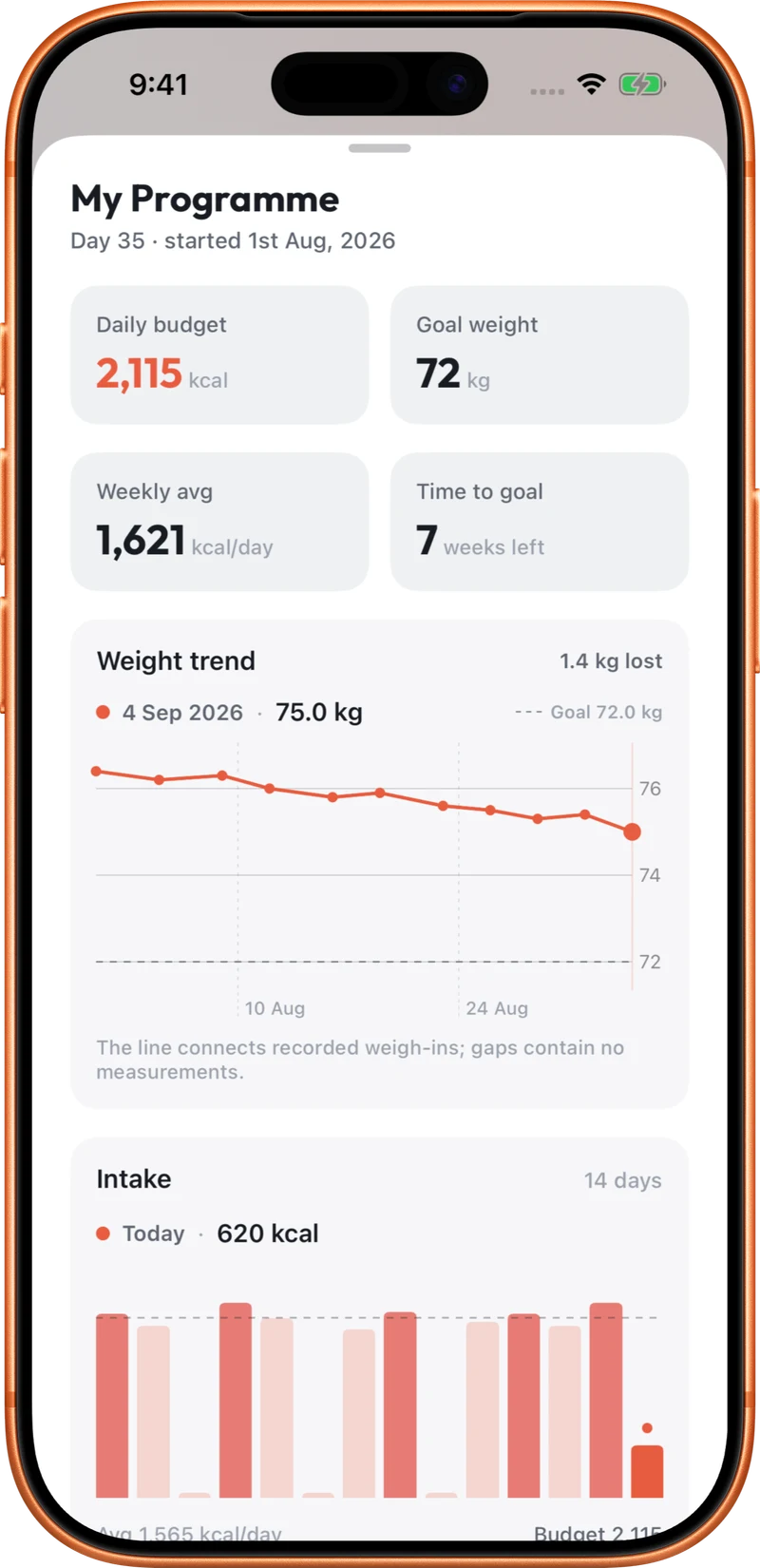
In CutWise, a Programme gives you a daily calorie target based on your profile, activity level and goal, and your logged meals count down against it.
Step 4: Follow the trend, not the daily number
Weigh yourself under similar conditions, for example in the morning before breakfast, and look at the direction over two to four weeks. A single weigh-in can be misleading.
The CutWise weight tracker keeps weigh-ins next to your food log, and can read weight from Apple Health with your permission.
What about exercise?
Activity raises the energy you use, but estimates of calories burned during a workout are approximate. If your activity level is already part of your target, adding workout calories on top can count the same activity twice.
That is why CutWise uses a steady daily target by default. If you want logged workouts to increase your food budget, you can opt into eating them back in onboarding or Settings. You can log a session by typing or saying something like “I did a 45 minute run” with the workout tracker.
When to adjust your target
If you have logged consistently for a few weeks and your weight trend has not moved in the direction you expected, revisit your numbers. Check for missed snacks, drinks and cooking fats first, then consider a modest change to your target or activity level.
Many people find that keeping protein reasonably high helps them feel full while eating less. See how to count macros for a simple way to set it.
When to get professional advice
Speak to a GP or registered dietitian before starting a calorie deficit if you are pregnant or breastfeeding, under 18, managing a medical condition or taking medication that affects appetite or weight, or if you have a history of disordered eating.