Type your age, height and weight into any calorie calculator and it will tell you, to the calorie, how much you need: 2,162 kcal a day, say. It looks precise. It isn’t. That number is an estimate built on two guesses, and for the same person the honest range can be 600 kcal wide.
That doesn’t make calculators useless. It makes them a starting point. The real number, the one that actually predicts what your weight will do, is already sitting in your own food log and your weigh-ins. Here’s how to get it out.
How a calorie calculator works
Almost every calculator does the same two steps.
- Estimate your resting burn. This is the energy your body uses lying still: breathing, circulation, keeping warm. The most widely used formula, Mifflin-St Jeor, comes from a 1990 study that measured several hundred adults and fitted an equation to height, weight, age and sex.2
- Multiply it by an activity factor. Usually 1.2 for “sedentary”, 1.375 for “lightly active”, 1.55 for “moderately active”, and so on. You pick the description that sounds like you.
Both steps carry real error, and they multiply.
Error one: the formula is an average
A systematic review of the main equations found Mifflin-St Jeor to be the most reliable of them: it predicted resting burn within 10% of the measured value for more people than any other.1 That’s the best available, and it still means a fair share of people sit outside 10%, in both directions. The review also warned of “noteworthy errors” when the equation is applied to a single person rather than a population, which is exactly what a calculator does.
That isn’t a flaw in the maths. Two people with the same height, weight, age and sex genuinely burn different amounts, because of differences in muscle, organ size, hormones and how much they move without noticing.
Error two: nobody knows their activity level
The bigger problem is the multiplier. Is a desk job with a gym session three times a week “lightly” or “moderately” active? There’s no right answer, and the choice alone moves the result by hundreds of calories.
Fig. 1One person, one formula, a 650 kcal range
Put a 500 kcal deficit on the wrong end of that range and you’re either barely in a deficit or eating far less than you need. Both feel like the diet “isn’t working”, for opposite reasons.
A calculator is a guess about you. Three weeks of your own data is a measurement of you.
The three-week method
Your body is running the experiment for you every day. If you log what you eat and weigh yourself regularly, you can work out your maintenance from what actually happened.
- Eat normally and log everything for three weeks. Not a diet; just your usual food, logged as honestly as you can. Include the drinks and the cooking oil.
- Weigh yourself most mornings and use the smoothed trend, not single readings (here’s why the daily number is mostly water).
- Do the sum. Take your average daily intake. Take the change in your trend weight over the three weeks, multiply by about 7,700 kcal per kilo and divide by 21. Add that to your average intake if you lost weight, or subtract it if you gained.
Fig. 2The sum, with real-looking numbers
Three weeks is the minimum because daily weight swings by a kilo or more. Over a shorter window a salty weekend can masquerade as a real change. Four weeks is better, and the result keeps improving as you add data.
Then set your target
Once you know your real maintenance, a sensible deficit is a few hundred calories below it, aiming to lose roughly 0.5 to 1% of your body weight a week. The NHS uses 2,000 kcal a day for women and 2,500 for men as rough guides, which is useful for food labels and useless for you specifically.4
Recheck every month or two. As you lose weight your maintenance drops, by roughly 24 kcal a day for every kilo lost on Kevin Hall’s rule of thumb,3 which is why a deficit that worked in January can stall by March (more on that in why weight loss slows down).
Doing it in CutWise
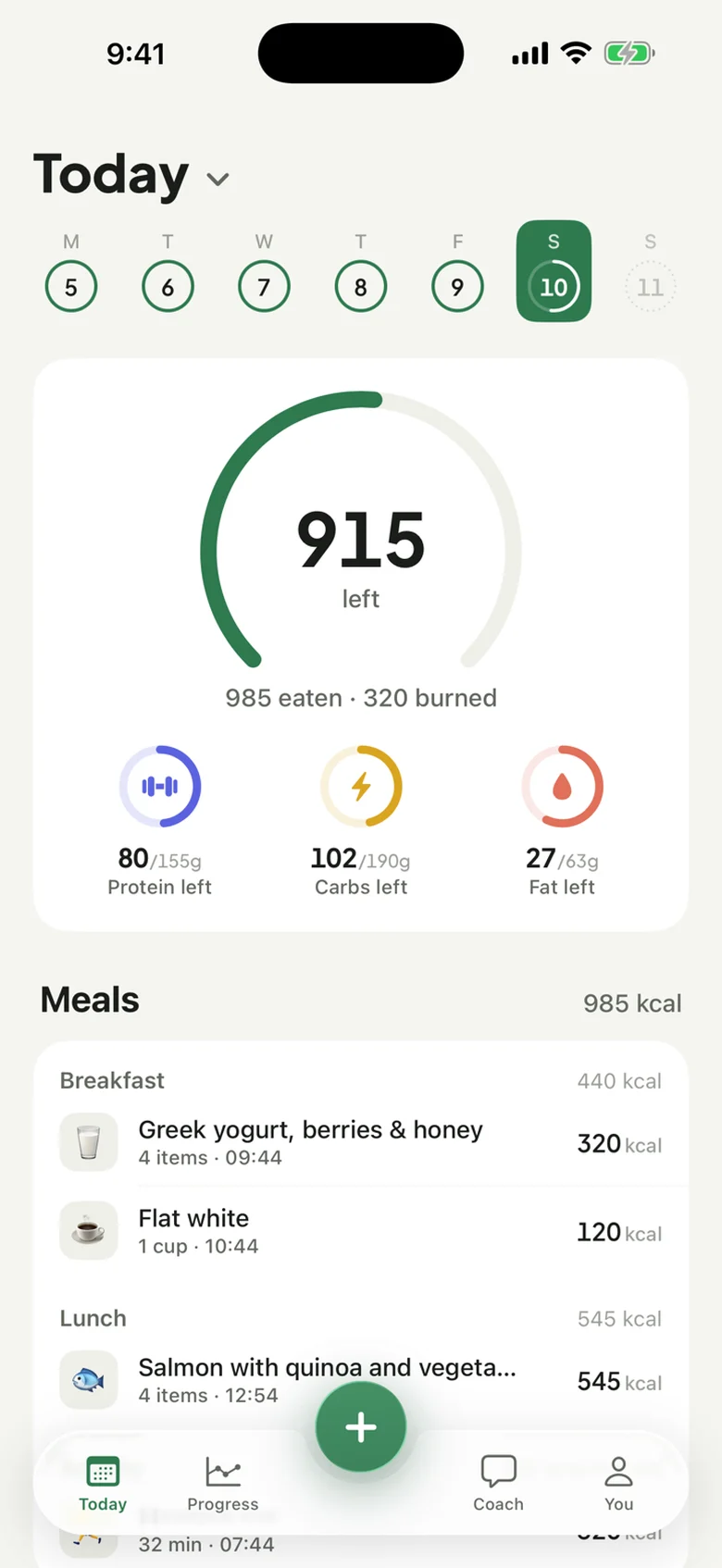
Use the calorie calculator (or a CutWise Program) for your starting estimate. Then log for three weeks and look at your Progress screen, where your average intake and smoothed weight trend sit side by side. That’s all the sum needs. After that, your number comes from you, not from a formula fitted to strangers in 1990.